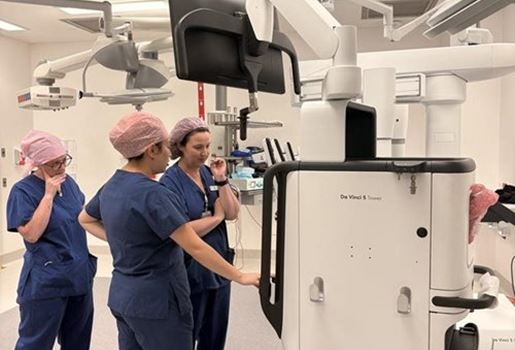
Colorectal surgeon Michael Johnston, Vice President of the Colorectal Surgical Society of Australia and New Zealand (CSSANZ), says the dV5 is the first robotic system to provide haptic feedback.
“The dV5 provides the ability to feel the tissue through your instrument,” Mr Johnston explained.
“Previously, you could see the tension being created, but now with sensors feeding back to the finger controls, it will immediately tell you if you are pulling or squeezing too hard. These are safety mechanisms built into to prevent pressure related damage.”
Urologist A/Prof Lih-Ming Wong says 95% of major urological surgery, like radical prostatectomies, are now done using the da Vinci robot.
“It’s great to see the robotic program expanding.
“With the robot, what you can see is magnified in 3D, an advantage to standard laparoscopic surgery. This depth perception helps you to pick things up,” A/Prof Wong said.
“Instruments are wristed so the degree of motion is a lot greater than what you can do with laparoscopic surgery. There is also no tremor, which you get with a human hand.
“Robots are particularly useful for urology because the prostate is anatomically in a difficult place to access at the bottom of the pelvis.
“With the extra theatres now available at Fitzroy Private following the completion of the new tower, we have extra capacity to more surgery.”
For urology patients, the difference in recovery rates has been huge. Twenty years ago, a radical prosectomy required open surgery and patients would spend about a week in hospital. Laproscopic surgery reduced that stay to 2.5 days and now with robotic surgery, the patient can go home after an overnight stay.
Mr Johnston adds that the constantly advancing technology provides a valuable training tool for up-and-coming surgeons.
“St Vincent’s was the first organisation to provide robotic training in the official colorectal program in Australasia.
“We have a dual console robot and I teach and train with those. Trainees come here to have access to those robotics for surgery and we have been providing that training across our Fitzroy precinct - in both our public and private hospitals.
“We have the ability to take trainees through the operation and supervise on our own controls, directing them,” he said.